Roles of Orexin (hypocretin) and Histamine in Sleep and Wakefulness
This content was developed using literature published in peer-reviewed journals.
Roles of Orexin (hypocretin) and Histamine in Sleep and Wakefulness
This content was developed using literature published in peer-reviewed journals.
Overview
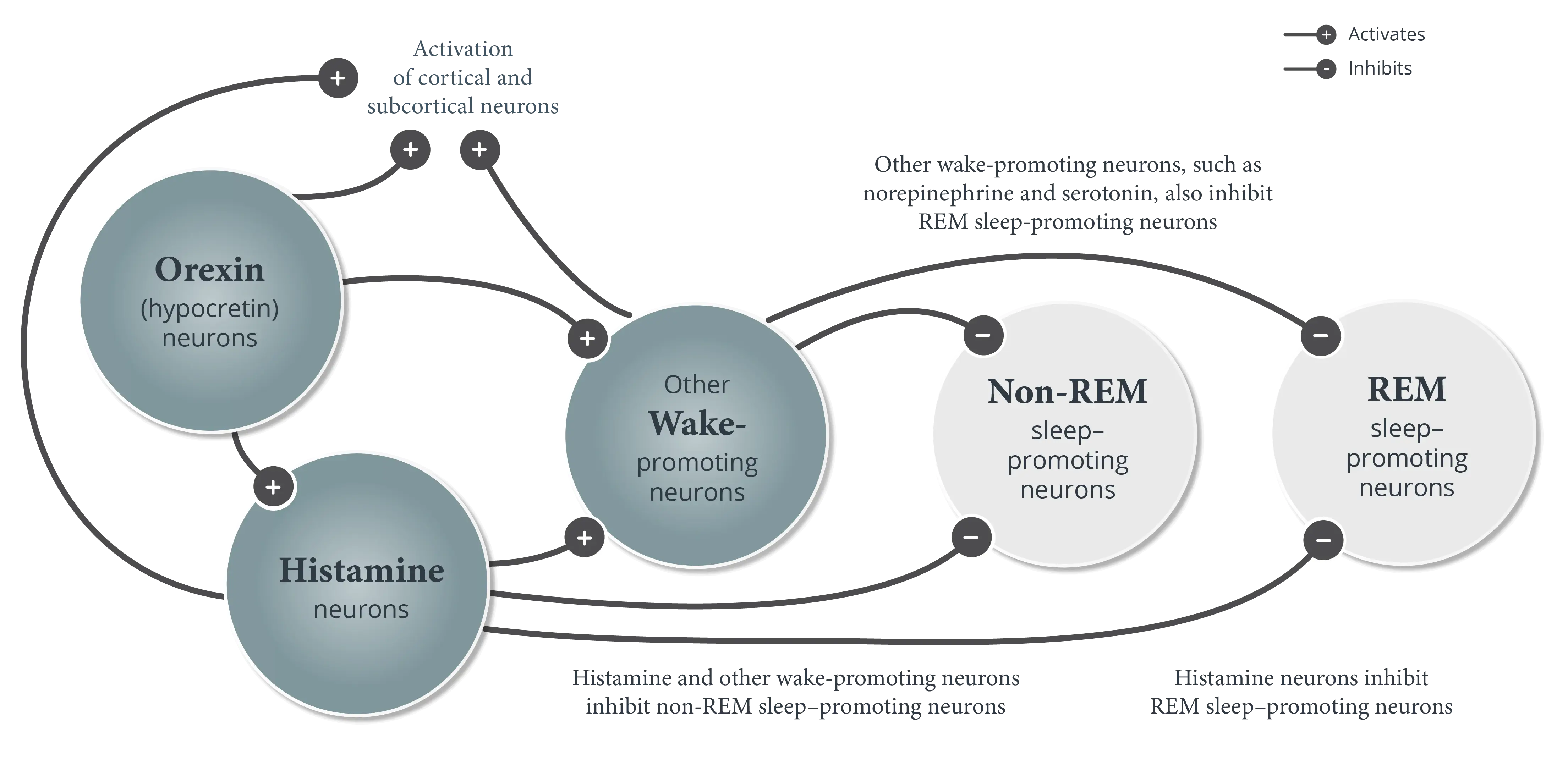
Orexin (hypocretin) and histamine both play important and distinct, yet complementary roles in promoting and stabilizing wakefulness.1-4
Orexin (hypocretin) and histamine-producing neurons both1-6:
- Originate in the hypothalamus
- Promote and stabilize wakefulness
Anatomical human studies have shown that orexin (hypocretin) and histamine neurons are located in close proximity to one another in the hypothalamus and project in largely overlapping patterns in the brain.5,6
- Orexin (hypocretin) neurons originate in the lateral hypothalamus (LH)3,7,8
- Histamine neurons originate in the tuberomammillary nucleus (TMN)3,4
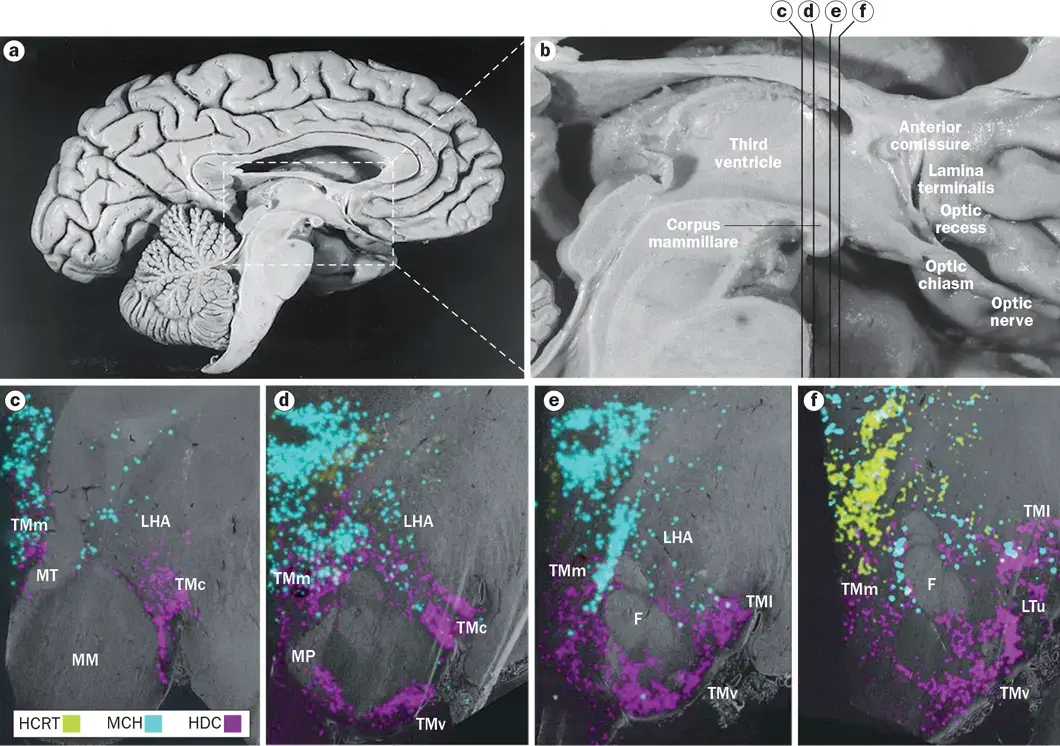
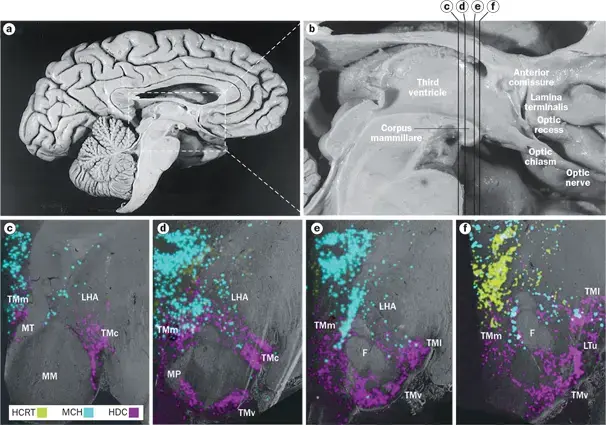

(a) Overview of the medial surface of the brain, and (b) detailed view of the hypothalamus. (c-f) The distribution of histidine-decarboxylase-positive neurons (histamine [HDC]; shown in purple), orexin (hypocretin [HCRT]; shown in green), and melanin-concentrating hormone neurons (MCH; shown in blue) shown through different levels of the hypothalamus.
Figure reprinted from Nat Rev Neurol: Shan L et al. Interactions of the histamine and hypocretin systems in CNS disorders. 2015;11. Copyright © 2015 Springer Nature; reprinted with permission from Springer Nature; permission conveyed through Copyright Clearance Center, Inc. Panels a and b reprinted from Handbook of Clinical Neurology. Vol 79. Swaab DF, ed. The human hypothalamus: basic and clinical aspects. Part 1: Nuclei of the human hypothalamus. Copyright 2003, with permission from Elsevier. Panels c–f: Krolewski DM et al. Expression patterns of corticotropin-releasing factor, arginine vasopressin, histidine decarboxylase, melanin-concentrating hormone, and orexin genes in the human hypothalamus. Copyright © 2010 J Comp Neurol. Reproduced with permission of John Wiley & Sons Inc.
Furthermore, a study in histamine receptor knockout models showed lower levels of orexin (hypocretin) in the brain compared with controls, with a greater reduction observed in H1-receptor knockout mice.9
Orexin (hypocretin) and histamine both play important and distinct, yet complementary roles in promoting and stabilizing wakefulness.1-4
- Orexin (hypocretin) neurons are involved in behavioral arousal and locomotor aspects of wakefulness, whereas histamine neurons contribute to cortical activation and aspects of cognition during wakefulness1
In mice lacking the histamine H1 receptor, the arousal-promoting effect of orexin-A is reduced.10
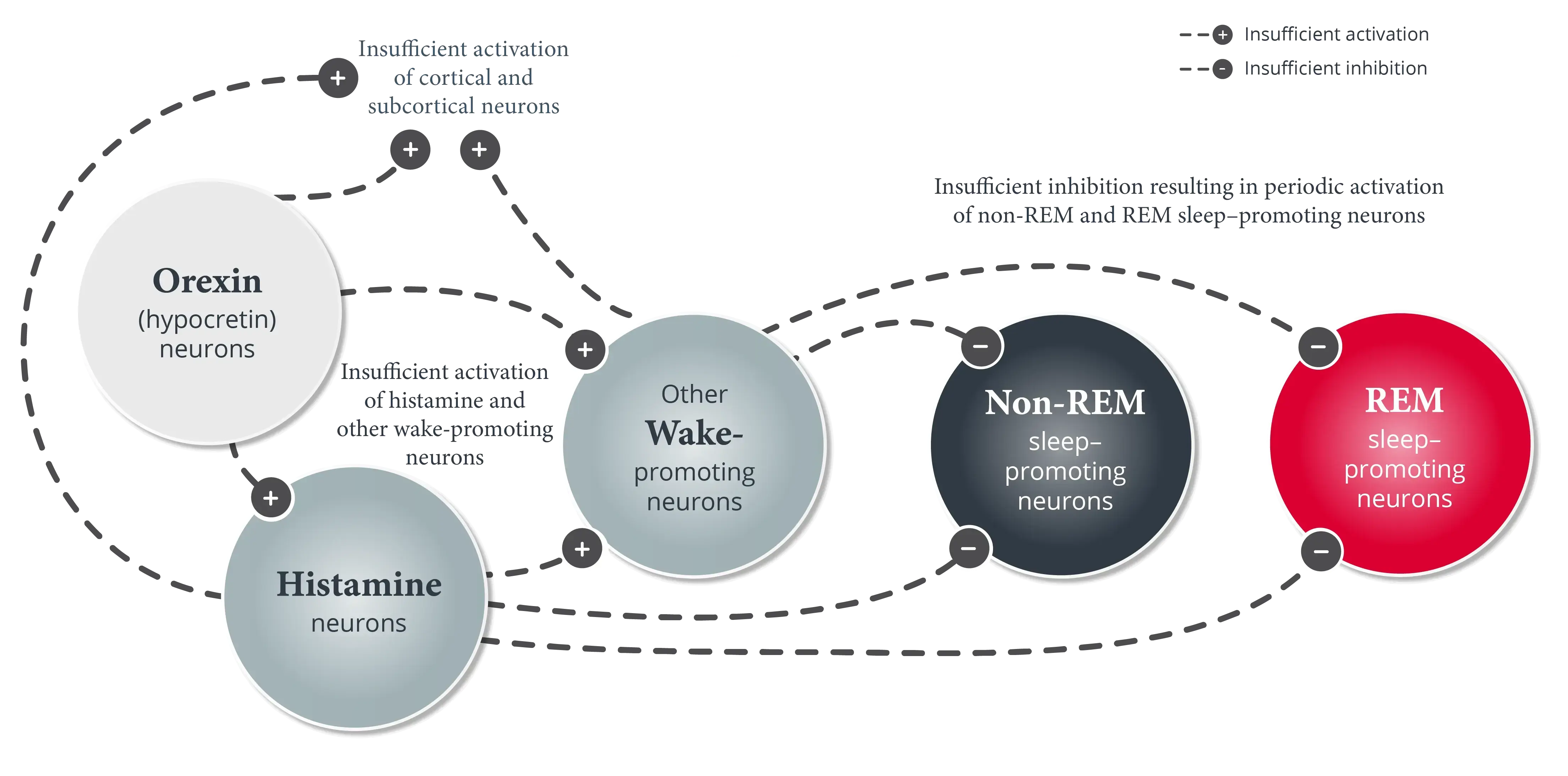
Chronic loss or chemogenetic inhibition of histamine neurons in rodents results in fragmented sleep and abnormal or delayed transitions between sleep and wake states.11
Lastly, animal studies suggest that the complex processes of controlling wake and sleep in the brain cannot be explained by the activity of one single group of neurons, and therefore are likely the result of multiple neuronal systems.1
Read about the pathophysiology of narcolepsy and how orexin (hypocretin) and histamine come into play there.
References
- Anaclet C, Parmentier R, Ouk K, et al. Orexin/hypocretin and histamine: distinct roles in the control of wakefulness demonstrated using knock-out mouse models. J Neurosci. 2009;29(46):14423-14438.
- Scammell TE, Jackson AC, Franks NP, Wisden W, Dauvilliers Y. Histamine: neural circuits and new medications. Sleep. 2019;42(1):zsy183. doi:10.1093/sleep/zsy183
- Scammell TE, Arrigoni E, Lipton JO. Neural circuitry of wakefulness and sleep. Neuron. 2017;93(4):747-765.
- Haas HL, Sergeeva OA, Selbach O. Histamine in the nervous system. Physiol Rev. 2008;88(3):1183-1241.
- Shan L, Dauvilliers Y, Siegel JM. Interactions of the histamine and hypocretin systems in CNS disorders. Nat Rev Neurol. 2015;11(7):401-413.
- Krolewski DM, Medina A, Kerman IA, et al. Expression patterns of corticotropin-releasing factor, arginine vasopressin, histidine decarboxylase, melanin-concentrating hormone, and orexin genes in the human hypothalamus. J Comp Neurol. 2010;518(22):4591-4611.
- Schwartz JRL, Roth T. Neurophysiology of sleep and wakefulness: basic science and clinical implications. Curr Neuropharmacol. 2008;6(4):367-378.
- Scammell TE. The neurobiology, diagnosis, and treatment of narcolepsy. Ann Neurol. 2003;53(2):154-166.
- Lin L, Wisor J, Shiba T, et al. Measurement of hypocretin/orexin content in the mouse brain using an enzyme immunoassay: the effect of circadian time, age and genetic background. Peptides. 2002;23(12):2203-2211.
- Huang ZL, Qu WM, Li WD, et al. Arousal effect of orexin A depends on activation of the histaminergic system. Proc Natl Acad Sci USA. 2001;98(17):9965-9970.
- Yu X, Ma Y, Harding EC, et al. Genetic lesioning of histamine neurons increases sleep-wake fragmentation and reveals their contribution to modafinil-induced wakefulness. Sleep. 2019;42(5):zsz031. doi:10.1093/sleep/zsz031