Neurotransmitters in the Sleep-Wake Cycle
This content was developed using literature published in peer-reviewed journals.
Neurotransmitters in the Sleep-Wake Cycle
This content was developed using literature published in peer-reviewed journals.
Overview
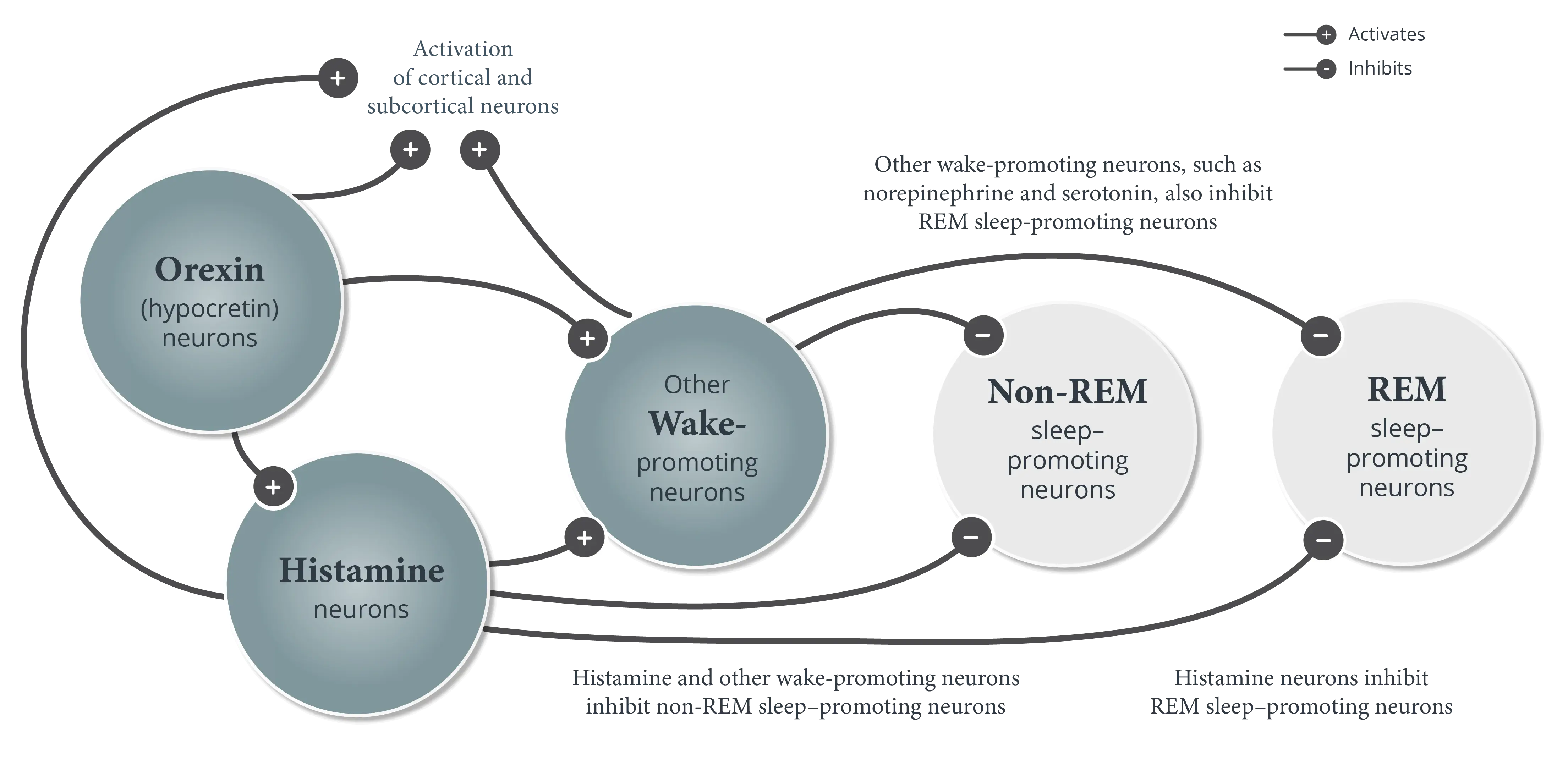
Multiple neuronal systems are involved in promoting and stabilizing wakefulness.1
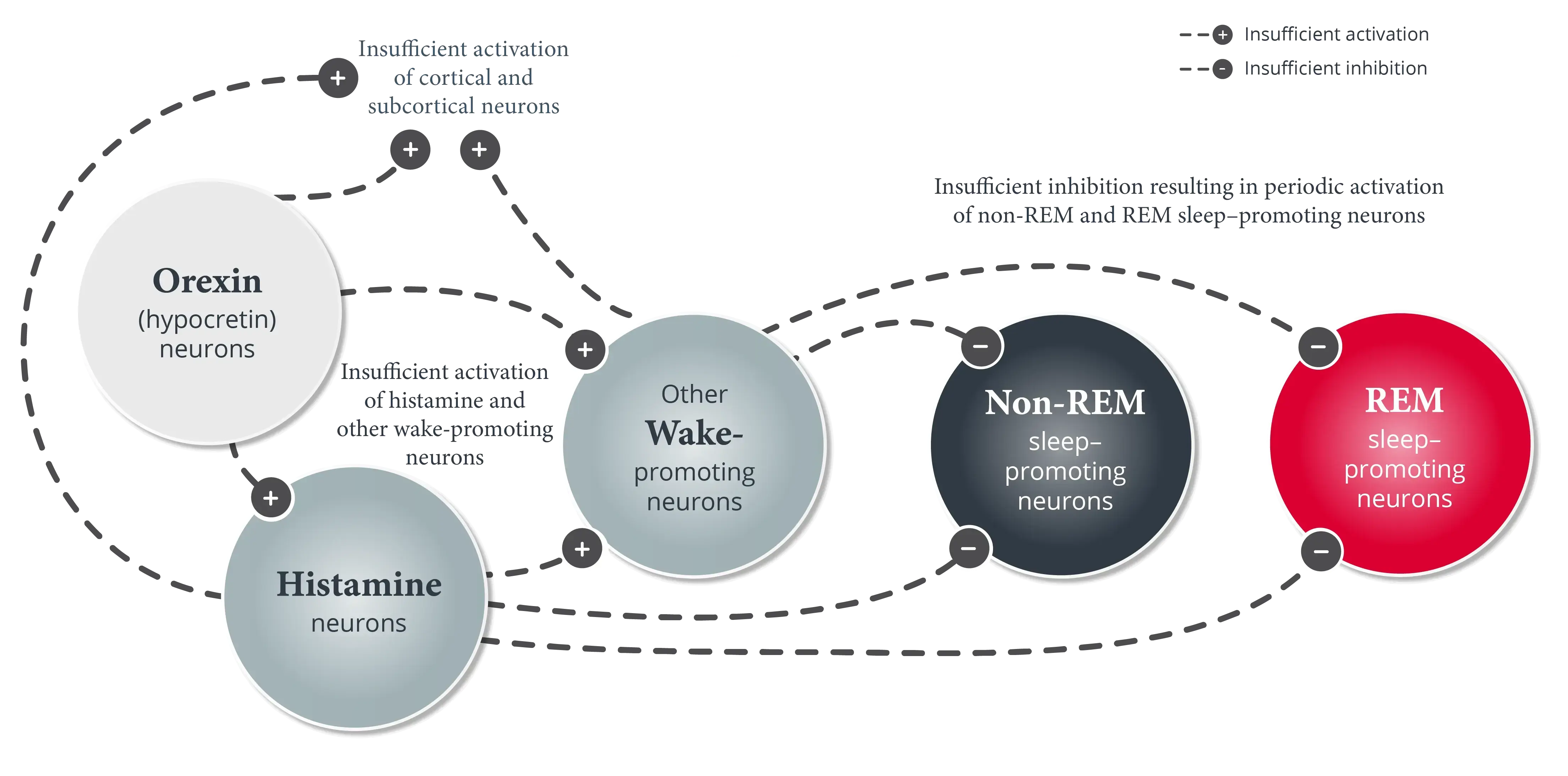
Orexin (hypocretin) and histamine play distinct yet complementary roles, activating a wide network of downstream neurotransmitter systems in key areas of the brain to promote and stabilize wakefulness.2-5
These neurotransmitters are produced by distinct nuclei at different levels of the forebrain and brainstem and send diffuse, widespread projections throughout the brain to regulate sleep and wakefulness.1
These neurotransmitters include1,6:
- Norepinephrine, produced primarily by neurons in the locus coeruleus
- Dopamine, mainly produced by the ventral tegmental area, substantia nigra, and ventral periaqueductal gray
- Acetylcholine, released by neurons in the basal forebrain, laterodorsal tegmentum, and pedunculopontine tegmentum
- Serotonin, produced by neurons in the dorsal and medial raphe nuclei
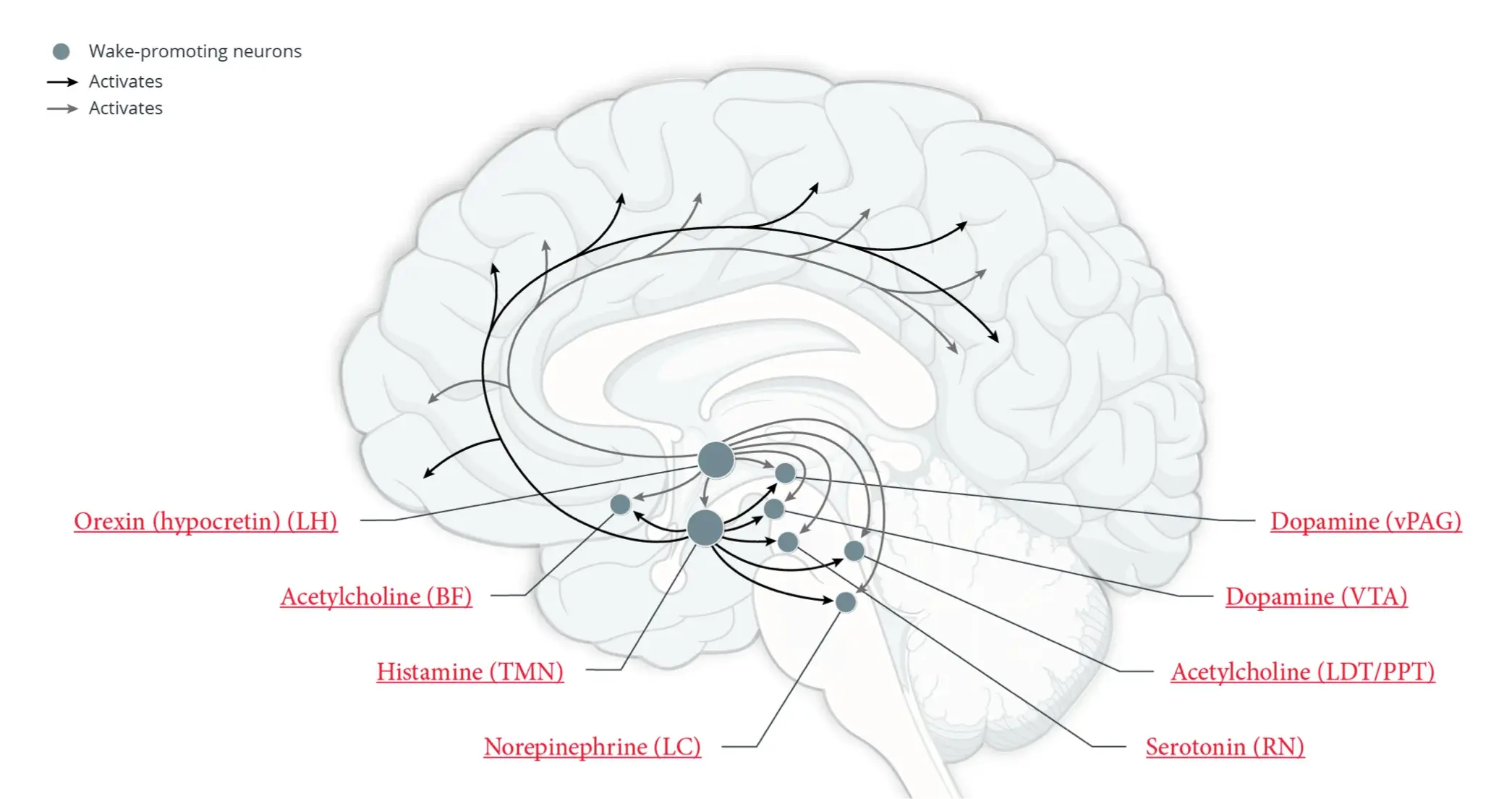
Select a neurotransmitter to see more information about it.
BF, basal forebrain; LC, locus coeruleus; LDT, laterodorsal tegmentum; LH, lateral hypothalamus; PPT, pedunculopontine tegmental nucleus; RN, raphe nuclei; TMN, tuberomammillary nucleus; vPAG, ventral periaqueductal gray; VTA, ventral tegmental area.
Dopamine neurons12-17
- Release dopamine, which acts as an arousal agent in the brain, with elevated levels during wakefulness
- Are stimulated by both orexin (hypocretin) and histamine-producing neurons to release dopamine in areas associated with higher cognitive, motivational, and goal-oriented behavior, such as the prefrontal cortex, ventral tegmental area, and nucleus accumbens
- Are affected by histamine during development; their activity may also be differentially influenced by histamine, as shown in the ventral midbrain in rats
Learn more about the normal sleep-wake cycle.
References
- Thorpy MJ, Bogan RK. Update on the pharmacologic management of narcolepsy: mechanisms of action and clinical implications. Sleep Med. 2020;68:97-109.
- Anaclet C, Parmentier R, Ouk K, et al. Orexin/hypocretin and histamine: distinct roles in the control of wakefulness demonstrated using knock-out mouse models. J Neurosci. 2009;29(46):14423-14438.
- Scammell TE, Arrigoni E, Lipton JO. Neural circuitry of wakefulness and sleep. Neuron. 2017;93(4):747-765.
- Scammell TE, Jackson AC, Franks NP, Wisden W, Dauvilliers Y. Histamine: neural circuits and new medications. Sleep. 2019;42(1):zsy183. doi:10.1093/sleep/zsy183
- Haas HL, Sergeeva OA, Selbach O. Histamine in the nervous system. Physiol Rev. 2008;88(3):1183-1241.
- España RA, Scammell TE. Sleep neurobiology from a clinical perspective. Sleep. 2011;34(7):845-858.
- Shan L, Dauvilliers Y, Siegel JM. Interactions of the histamine and hypocretin systems in CNS disorders. Nat Rev Neurol. 2015;11(7):401-413.
- Krolewski DM, Medina A, Kerman IA, et al. Expression patterns of corticotropin-releasing factor, arginine vasopressin, histidine decarboxylase, melanin-concentrating hormone, and orexin genes in the human hypothalamus. J Comp Neurol. 2010;518(22):4591-4611.
- Scammell TE. The neurobiology, diagnosis, and treatment of narcolepsy. Ann Neurol. 2003;53(2):154-166.
- Scammell TE. Narcolepsy. N Engl J Med. 2015;373(27):2654-2662.
- Osorio-Forero A, Cardis R, Vantomme G, et al. Noradrenergic circuit control of non-REM sleep substates. Curr Biol. 2021;31(22):5009-5023.
- Oishi Y, Suzuki Y, Takahashi K, et al. Activation of ventral tegmental area dopamine neurons produces wakefulness through dopamine D2-like receptors in mice. Brain Struct Funct. 2017;222(6):2907-2915.
- Eban-Rothschild A, Rothschild G, Giardino WJ, Jones JR, de Lecea L. VTA dopaminergic neurons regulate ethologically relevant sleep-wake behaviors. Nat Neurosci. 2016;19(10):1356-1366.
- Kalló I, Omrani A, Meye FJ, de Jong H, Liposits Z, Adan RAH. Characterization of orexin input to dopamine neurons of the ventral tegmental area projecting to the medial prefrontal cortex and shell of nucleus accumbens. Brain Struct Funct. 2022;227(3):1083-1098.
- Torrealba F, Riveros ME, Contreras M, Valdes JL. Histamine and motivation. Front Syst Neurosci. 2012;6:51. doi:10.3389/fnsys.2012.00051
- Escobedo-Avila I, Vargas-Romero F, Molina-Hernández A, et al. Histamine impairs midbrain dopaminergic development in vivo by activating histamine type 1 receptors. Mol Brain. 2014;7:58. doi:10.1186/s13041-014-0058-x
- Fleckenstein AE, Lookingland KJ, Moore KE. Differential effects of histamine on the activity of hypothalamic dopaminergic neurons in the rat. J Pharmacol Exp Ther. 1994;268(1):270-276.
- Siegel JM. The neurotransmitters of sleep. J Clin Psychiatry. 2004;65 Suppl 16(Suppl 16):4-7.